Showing posts with label Historic Cemeteries. Show all posts

Wednesday, October 21, 2020

Cemetery Fencing: Artwork in its Own Right

 In this installment of our October Cemetery Series, we will be discussing fencing. Yes, that’s right! Fences are something we don’t see much of in modern cemeteries, mainly because they make maintenance more complicated, but they were commonplace in historic cemeteries. Here in Tallahassee, both St. John’s Episcopal Cemetery and Old City Cemetery have wonderful examples of Victorian Era ironwork fencing. There are three general types of fencing that you will find in most cemeteries: wrought iron, cast iron, and woven wire. When doing repair work it is very important to understand what type of fencing you are working with. 


Just one example of the ornate fences you 
can find at Old City Cemetery (courtesy of 
Florida Center for Instructional Techonology)
Wrought iron
(also called puddled or charcoal iron) is the material commonly used by blacksmiths. It is almost pure iron, but also contains a small amount of glassy slag, which is what causes it to form malleable  linear fibers. Wrought iron is easy to work with and great for delicate artwork. This material does not corrode very easily and is not brittle or very breakable. These characteristics make it great for intricate fence work. Cast iron has a higher carbon content than wrought iron, and can be easily poured into molds. This characteristic makes it good for manufacturing replicated fencing details. However, it is hard and brittle, thus it cannot be shaped by hammering, rolling, or pressing like wrought iron. Woven wire fencing was less expensive than other fencing materials, and oftentimes were much more intricate than our typical chain link type fencing we see today. Unfortunately, their delicate nature means that they are usually not well preserved, and often seen damaged by mowing, vegetation overgrowth, or corrosion. 


Often when we visit cemeteries we will see the fencing painted black. While some fences were most definitely painted black, it wasn’t necessarily the default for all of the fencing. In fact, many fences were elaborately painted with a multitude of colors. When doing fence repair work, it is worthwhile to take the time to try to find the original colors by looking around fasteners and nooks and crannies. Sometimes you may be surprised at what you find. If you have ever taken a stroll through New Orleans, you may have noticed numerous examples of painted cast iron fences adorning the gardens of many of the historic homes. While many think this is a modern occurrence having to do with the colorful culture of the city, this actually depicts quite accurately what many iron fences actually looked like historically.


Fencing was often used to delineate family plots or individual burials. They are one of the unique characteristics of historic cemeteries, rarely seen in more modern cemeteries. Unfortunately, there is a growing elicit market for cemetery gates, fencing, benches and other ironwork. It is important to understand that removing such materials is against the law, as well as extremely disrespectful. Owners and caretakers should take steps to secure all materials. The National Park Service and the Chicora Foundation both have resources available to help preserve and protect these unique historic cemetery features. The first step should include an inventory and photographic documentation of all the fencing within the cemetery. This helps with proper repair should it become damaged and can assist you in identifying items belonging to the cemetery should something be removed. 


Historic fencing is something, along with  historic grave markers, that should be documented and assessed regularly and repaired when necessary. Some of the preservation does require specialized skill, but some can also be done by trained volunteers. The Wisconsin Historical Society hosted a wonderful webinar on the repair and care of ornamental fences. These fences are characteristic of Victorian Era cemeteries, and while many folks tend to pass over them with just a glance, it is definitely worthwhile to stop and admire their beauty and intricate designs. They are truly pieces of art worthy of admiration!


Monday, October 12, 2020

An Imposter Among Stone: White Bronze Monuments

 If you have ever noticed a monument in a cemetery that looked a lot like stone, but actually

Samuel Sheppards white
bronze monument at 
Old City Cemetery.
(courtesy of findagrave.com)
appears to be made of some type of metal, you probably have stumbled upon what is commonly referred to as a “white bronze” marker. These markers are actually not bronze at all, but an alloy of varying amounts of copper, tin, and zinc. Oftentimes, these markers tend to stand out in the cemetery because they appear in better shape, or cleaner than their stone neighbors. White bronze monuments are non-porous and resistant to corrosion and degradation over time. They don’t tarnish and many appear deceptively brand new, often with a bluish-grey color, which was a result of the finishing process. The monuments were sandblasted and finished using a process called “steam bluing” to give them their stone-like appearance. Steam bluing involves coating the monument in linseed oil and then steaming it at high pressure. 


Monumental Bronze Company 
catalog page illustrating some
common motifs that were available.
(Courtesy of The Smithsonian)

These monuments were marketed as an affordable option that would stand up to wear and tear. They were one third the price of stone or granite markers at the time. The term “White Bronze” was a marketing strategy to make the monuments more appealing to the masses. 
Some cemeteries banned them, possibly at the request of local granite and marble monument manufacturers. Some saw white bronze to be a cheap imitation of solid granite. Nevertheless, these monuments appear in cemeteries all over North America, from the west to the east coast, and into Canada. Each one is unique, as they were made to order. Over 500 designs were available and the purchaser chose their base, monument and attached panels from a catalog. These monuments were not sold in local stores, but were marketed and sold by sales agents. The price ranged from $10 to $5000, depending on the desired specifications. Often they will have removable panels that were bolted on using a specialized tool. This was so that new names could be added in cases where one monument represented multiple individuals. These panels continued to be manufactured until 1939, several decades after manufacturing of the monuments had come to an end.


The Monumental Bronze Company plant in 
Bridgeport, Connecticut (courtesy of A Grave 
Interest
)

The technique was developed by Milo Amos Richardson in Chautauqua, New York in 1873. He attempted to establish his own manufacturing company, but in the end sold the rights to the Monumental Bronze Company. The Monumental Bronze Company in Bridgeport, Connecticut was the sole manufacturer of these monuments from 1874 to 1914. Although the original casting was done in Bridgeport, Monumental Bronze had foundries and assembly plants in Chicago, Des Moines, Detroit, Philadelphia, New Orleans, and St. Thomas, Canada.


As previously mentioned, these monuments were made of a metal alloy. They were manufactured as vertical panels that were then assembled using screws. The inside of the monument is hollow, which has lent itself to stories of bootleggers hiding contraband and alcohol in them during Prohibition. However, we couldn’t find any concrete proof to back that up. What we do know is that while these monuments are extremely sturdy, some of the heavier ones will start to sag, requiring internal supports. Quite often we also see the seams that were fused start to come apart as the monument ages or sags.


The manufacturing of white bronze monuments came to an end during World War I. The Monumental Bronze Company was taken over by the U.S. government to manufacture gun mounts and munitions for the war effort. After the war, demand for metal monuments had declined, but they continued to make the metal panels until 1939. Most of their manufacturing shifted to things such as fabricating castings for automobile parts, radio parts, and kitchen equipment. The company did not survive the Great Depression and ended up closing after filing bankruptcy in 1939.


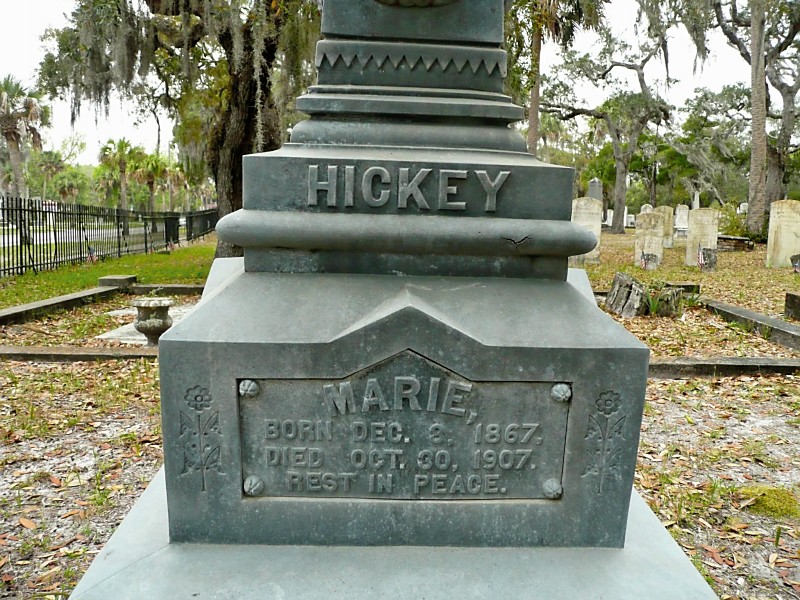
Marie Murat Hickey's white bronze marker at 
Chestnut Street Cemetery in Apalachicola
(Courtesy of findagrave.com)

If you have never noticed any white bronze monuments in a cemetery, there are a few in the local Big Bend and Tallahassee area you can check out. In Old City Cemetery in downtown Tallahassee (where Bessie’s monument is also located) there is the white bronze monument for the grave of Samuel Allen Sheppard (d. 1897). In Chestnut Street Cemetery in Apalachicola there is the grave of Marie Murat Hickey (d. 1907). Her husband,Patrick Hickey (d. 1907) has an identical white bronze marker in nearby  Magnolia Cemetery. According to local lore, Marie cut her husband’s throat  at their home above a local store, and then cut her own throat! However, we could not find a single piece of documentary evidence to prove this story to be true. Talk about a history mystery though! If you know of any such documentation or of any other local white bronze monuments, we would love to hear from you! You can read further about these monuments by checking out the links below as well. 


Resources and more information:


Connecticuthistory.org https://connecticuthistory.org/monumental-bronze-company/


Mount Olive Cemetery, Inc. http://www.mountolivetcemeteryinc.com/stories-in-stone-blog/white-bronze-markers


Stephen F. Austin State University http://www.sfasu.edu/heritagecenter/4687.asp

The Smithsonian (great images of Monumental Bronze Company Catalogs!) https://library.si.edu/digital-library/book/whitebronzemonu00monu


A Grave Interest Blog http://agraveinterest.blogspot.com/2012/06/white-bronze-monument-of-quality.html

Monday, October 5, 2020

A Lesson In Cemetery Symbolism: Elizabeth Budd Graham was not a Witch, and This is How We Know, Part 2

John Alexander Graham,
Bessie's husband. (photo
courtesy of findagrave.com)
 

 In our last post we discussed the symbolism of Elizabeth Budd Graham’s grave and how it proved that she was not a witch. Now we are going to explore what little written information there is about Elizabeth in the historical record. As was common for the time, there is much more information out there about her husband, John Alexander Graham, and other male relatives than there is about her. But thankfully, there is some information out there, such as her obituary and genealogical information. We  can use that information to learn more about her and learn who the real person was behind all the lore.


We have already talked a little bit about her obituary in the last post, but let us dive further, as it is a good place to start when researching any deceased person. An obituary can provide information like important dates, places and relatives. One important date that has contributed to the witch myth is her birth date. Yes, she was born in October, but by that logic everyone born in October would have to be a witch, right?  I have provided her obituary in its entirety below. 


Obituary: A Sad Death


Early this morning at the dawning of a new day the insatiate reaper, death, claimed Bessie, the lovely young wife of Mr. John A. Graham, at their family residence, 64 East Duval street. Mrs. Graham had been slightly unwell for a day or two, but no one anticipated so sudden and sad a termination. Last night she was much troubled with her heart and between 4 and 5 o'clock she quietly and peacefully passed away, we hope, to a better and brighter home in the unknown beyond. Possessed of rare personal beauty and excellent traits of character that her young life should so suddenly and abruptly terminated when all before her appeared so happy and pleasant. The blow fell hard with crushing effect upon the young husband, who loved and adored his wife with all the affection possessed by human nature. Mrs. Graham was the daughter of Mr. and Mrs. David Wilson of Tallahassee, and niece of Mr. C.W. Smith, of this city. She leaves besides her husband and one babe a number of other relatives residing at Monticello and Tallahassee.-Metropolis, 16th. The remains were brought to Tallahassee for internment, arriving Sunday afternoon, and were followed to the grave by a large concourse of sympathizing friends, the funeral being from the residence of the parents of the deceased, Mr. and Mrs. David C. Wilson, at 3:30 p.m.


We had assumed that since she was buried in Tallahassee, that she and her husband lived here. However, an initial search found there to be no East Duval Street in Tallahassee (note the address in her obituary), although there is a Duval Street that runs north and south. This caused a little confusion at first during our research. There is an East Duval Street in Jacksonville, however. Unfortunately, the address 64 East Duval Street is now a paved parking lot. We were hoping to possibly find a historic home in that location dating to the time Bessie and John would have resided there, but no such luck. The obituary mentions that her remains were brought to Tallahassee, but not from what location. Was she visiting her family in the area when she became ill or was she brought here from Jacksonville after she passed? Either way, she was most likely buried in Old City Cemetery because of her familial ties to the area, as evidenced by her surviving relatives mentioned in the obituary. The 1880 U.S. Census data shows that her residence was  in Jacksonville and not Tallahassee. 


Her tombstone inscription states that she was a mother, but we cannot find any concrete evidence of who her child was. Her obituary mentions one baby, but no name. Her husband did remarry to  Nina Hayward Graham. There are two children tied to John Andrew Graham. One is John Graham, Jr. (mentioned as a surviving family member in the 1921 obituary) and the other is Harriet (who passed in 1913, of unknown age). Harriet is also mentioned as Nina’s child, so we are left to assume that John Graham, Jr. was perhaps Elizabeth’s surviving child. 


In researching Elizabeth’s parents, David C. Wilson, Jr. and Florence J Smith Wilson, we learn that they were married in 1866 (the same year Bessie was born). David was born in Jefferson County and served in the Confederate Army during the Civil War. David passed in 1906 and is buried at Tallahassee’s Old City Cemetery, which further confirms why Elizabeth may have been buried there as well. It is also interesting to note that David’s monument is also an obelisk, although not as large or ornate as Elizabeth’s, but still can be viewed as a sign of the family’s wealth and prestige. Florence passed years later in 1929 at the age of 81. At the time she had been living in Jacksonville and her obituary states she was living “at the home”. We are unsure what that means, but perhaps she was living at a retirement home. There was a Confederate Old Soldiers Home in Jacksonville, but it was for soldiers only, so it is not likely that Florence, even as the widow of a CSA veteran, was living at that home. She was buried at Evergreen Cemetery in Jacksonville after a funeral service at St. Marks Episcopal Church. This may explain Elizabeth’s ties to Jacksonville and may be why she was listed as living there in the 1880 census.


We went as far back as Elizabeth’s grandparents and found something interesting that is further

Elizabeth's Grandfather,
David Wilson, Sr. (photo
courtesy of findagrave.com)
evidence that she was not a witch, but in fact had long ties to the Christian church. Her grandmother on her father’s side,
Elizabeth Shirley Wilson, along with her descendants were members of the Presbyterian Church in Tallahassee. Her grandfather, David C. Wilson, Sr. was an elder and one of the founders of the First Presbyterian Church and gifted the tower bell. The First Presbyterian Church is an interesting landmark itself, and is the oldest continually operating public building in Tallahassee. It is fascinating to find a connection between it and Elizabeth Budd Graham. 


In researching Elizabeth Budd Graham, we became curious where the name Budd came from. Her maiden name was Wilson, so we dug a little deeper and found that her great-grandmother was named Elizabeth Kershaw Budd Smith and is buried in a different Old City Cemetery in Monticello (you have to be careful with cemetery names because there are a lot of duplicates out there!). Budd was her great grandmother’s maiden name and her family had long ties to the area. 

All this being said, we hope that this has humanized Elizabeth Budd Graham for you and convinced you that she was indeed not a witch. She was descended from a prominent family with a long history in both Tallahassee and Monticello. She and her family were all upstanding citizens, heavily involved in the church. In fact they were founding members of one of the most historic

Historic photo of First Presbyterian 
Church (photo courtesy of First
Presbyterian Church)

churches in Tallahassee! While it is fun to imagine witches and haunts in historic graveyards, it is important to remember that behind each and everyone of those monuments is a human being and that those monuments were placed there by those that loved and mourned them. Besides, the real stories of those buried in historic cemeteries is usually much more fascinating than the myth. Historic cemeteries are essentially outdoor museums and a great way to get to know a community’s history by connecting the people buried there with the historic landscape. In fact, in this case, the Tallahassee Old City Cemetery is only a few blocks away from the historic First Presbyterian Church.


Thursday, December 12, 2019

Rest in Peace: Protecting Historic Cemeteries from Natural Disasters

In October 2018, Hurricane Michael hit the Gulf Coast of Florida. The impact from this storm was more
devastating and widespread than anyone had anticipated. Not only were coastal communities severely impacted,
but the reach of the storm was felt all the way into Southern Georgia. Countless historical and archaeological
sites were impacted, including many historic cemeteries. Over time patterns of damage have emerged. There is
much that we can learn from these patterns to ensure historic cemeteries are adequately prepared for natural
disasters. Both archaeologists and cemetery managers need to work together to ensure historic cemeteries are
adequately prepared for natural disasters, especially as intensity and frequency of storms continue to increase
due to climate change. 


A tree uprooted during Hurricane Michael and
took with it curbing, headstones, and ledgers.
Hurricane Michael:


•Made landfall near Mexico Beach on October 10, 2018.
•First Category 5 to hit Florida since Andrew in 1992.
•Maximum sustained winds of 160 mph.
•59 deaths in the U.S., 15 deaths in Latin America.
•Caused an estimated $25.1 billion in damages in U.S.
•An estimated $6.23 billion in insurance claims.
•14 ft. storm surge flattened homes in Mexico Beach.
•Caused major structural damage as far inland as Mariana, 54 miles from the coast.


Damage Trends to Cemeteries after Hurricane Michael:

•Large ruts caused by  response vehicles driving on saturated ground.
•Trees uprooted, taking with them ledgers, curbing, headstones, possibly exposing human
remains.
•Large limbs falling and damaging monuments.
•Fallen trees landing on graves and markers.
•Large holes resulting from fallen trees and limbs.
•Fences damaged by powerline poles and trees.
•Wind and water primary concerns
•Storm surge
•Coastal erosion
•Ground saturation


Hurricane Damage to Cemeteries:


EVALUATE YOUR RISK


Response protocol should include pre-established contractors to call upon, volunteers to call on and chain of
command. It is also important to figure out what law enforcement district your cemetery is in and who patrols
your cemetery. Maintain a relationship with them and know how you can expect them to respond to emergency
situations. Make sure any drains you have on property are clear of debris and trash. Prior to a storm event, if
possible, pick up loose debris and ornaments and store in a secure location.


Assess your ability to recover:
•Staff/Volunteers
•Recovery Funds
•Insurance
•Include response protocol in cemetery management plan


Assess your surroundings:
•Trees
•Roads
•Drainage
•Structures
•Markers/Monuments


Historic headstones require the care of a
conservator that specializes in using appropriate
materials for repair. 
Tree Considerations:


One of the most beautiful things about historic cemeteries are the big trees, but they can pose a hazard if not
properly maintained. Pruned trees have a 70% survival rate, while unpruned trees only have a 46% survival rate.
Trees need maintenance, they cannot  simply be left to grow if you want to minimize the chances that they will
cause damage. Use a licensed and insured ISA certified arborist. Live oaks and a few other species will actually
shed their leaves prior to a storm as a way to decrease wind resistance. Planting different aged trees will ensure
you don’t end up with an empty field after a storm or after a long time as they naturally die. Any trees that are
dead or dying, have thick canopies, or have co-dominant trunks should be assessed to determine how to make
them safe.  Winds that are 35 mph or higher can damage any tree.


Trees together fare better than isolated trees.
Many arborist companies will evaluate trees for free.
Remove “widow makers” and dead/diseased trees.
Plant a variety of types and ages to maintain diversity.
Loss of leaves doesn’t always mean they are dead.
Old trees don’t weather storms as well as young trees.
Properly pruned trees survive better and are less likely to fall.
Soil compaction increases risk of fall during storm (avoid driving on or near roots).
Never cut roots shorter than five times the trunk diameter.
Fast growing trees more likely than slow growing trees to sustain damage.


Falling trees can also damage historic iron works which can
be difficult to repair.
Cemetery Monuments:


Evaluate your monuments before a storm, after a storm and on a regular basis to keep tabs on any
 potential issues. Talk to a conservator about any scaffolding or supports that may be helpful during
 a storm to stabilize leaning or damaged monuments. Documenting before the storm may be useful
 when applying for grants, funds or insurance money after storm. Again, know who you are going to
 call before a storm.  They will be busy after a storm and it may be difficult to find someone to help 
in a timely manner if you are cold calling after a disaster! Have a plan in place for how to deal with 
damaged stones after a storm. 


•Have them assessed by a conservator and repaired as necessary.
•Do a thorough documentation before a storm strikes.
•Setting compound is not adequate, metal or fiberglass pins should be used to prevent monuments
from slipping due to vandals or weather.
•Have a pre-established conservator you can call after a storm or when concerns arise (consider the
same with an arborist).


A few notes regarding FEMA funds:


FEMA funding is very limited and many people have unrealistic expectations due to a lack of 
understanding of what they will cover. Know if your cemetery is eligible before the storm, and know 
that FEMA will deal with basic needs first, so cemeteries may not be addressed immediately. It is not
 recommended that a historic cemetery or any historic resource rely on them as a primary source of
 recovery funding. It is better to create a fundraising campaign to start an escrow account or another
 means of emergency funding that will be readily available after an emergency.


Only public cemeteries are usually eligible for FEMA funds. FEMA limits monument repair to only 
those where it is the legal responsibility of the applicant. So states that have limited liability for
 monument damage have thus precluded obtaining any federal funding from FEMA. The governor of
 the state impacted must request the help and it is county specific. FEMA funds are primarily for 
debris removal, but remember it is reimbursable to qualified cemeteries, so you must have the
 initial funds to pay for the removal.


What archaeologists can do:

•Make contact and develop relationships with cemetery managers.
•Provide education (see FPAN’s Cemetery Resource Protection Training) and educate yourself.
•Encourage cemeteries to have a current management plan that includes disaster planning and
 response.
•Be available for questions and assistance.
•Establish relationships with disaster management agencies and organizations. 


Helpful Resources:


•Chicora Foundation Cemetery Disaster Planning
•National Center for Preservation Technology and Training (NCPTT)
                  https://www.ncptt.nps.gov/

•Natural Hazards Center
•“Be Prepared”, Heritage Collections Council (free book for download)
https://aiccm.org.au/disaster/disaster-planning

•CRPT Alliance Facebook Page

•Your local FPAN Regional Center